
 |
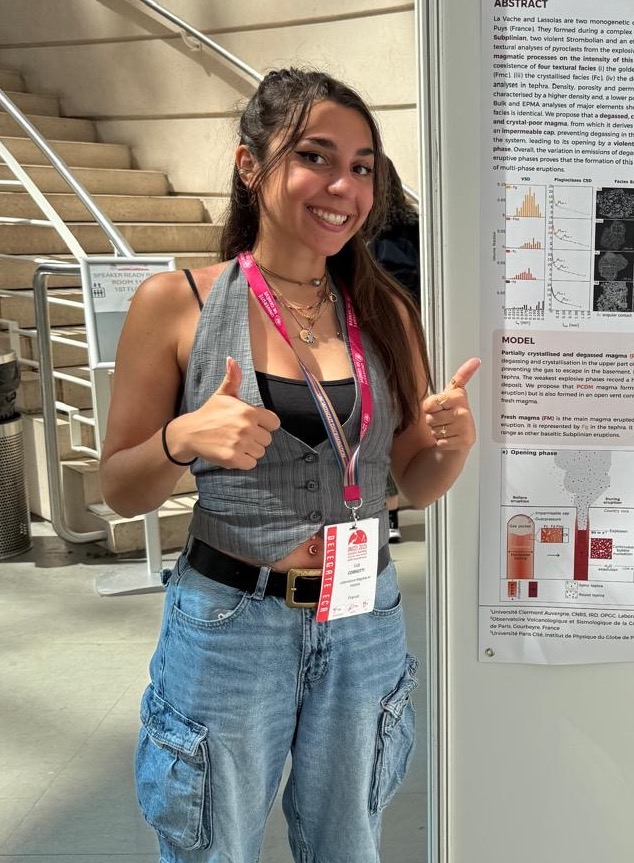
Lisa Corrotti
Doctorante 3ème année |
-
Thème et objectifs de thèse :
Titre de la thèse : Understanding eruptive dynamisms variability during an eruption.
Résumé :
The eruptive dynamisms variability during an eruption has been widely described (via the study of volcanic deposits) and observed (monitoring). These polyphased eruptions can alternate between explosive and effusive activity but can also vary in eruptive intensity giving rise to a wide range of explosive styles independently of the geological context and magma chemistry. The unpredictable nature of these variations within an eruption can pose a significant hazard for the surrounding populations. Therefore, to mitigate the associate impacts of these unforeseeable systems, it is essential to understand all the possible mechanisms that can provoke this variability. The causes of those variabilities may originate at different spatial and temporal scales in the magmatic system. Pre eruptive conditions such as magma temperature, magma degassing, magma stalling, crystal content and surroundings (storage conditions, contact with external water) may determinate the potential styles and possibles change in the course of the eruption. Syn eruptive processes that operate in the conduit (i.e. magma degassing, modification in conduit architecture, incorporation of external water) and in the deeper magmatic plumbing system (i.e. magma mixing) can enhance or inhibit the intensity of the eruption.
This thesis focuses on two very different target volcanoes and a total of three eruptions with the aim of covering a large range of dynamism and magma variability. The trachybasaltic eruption of La Vache et Lassolas marks the last eruption of the monogentic field of La Chaîne des Puys (France) 8.6 ky ago. They formed during a complex eruption marked by a Subplinian, two violent Strombolian and an effusive phase. La Soufrière de Guadeloupe produced 15 eruptions (GDS 15 to GDS 1) different in styles with six effusive (domes) and nine explosive eruptions (five Plinians, one Subplinian, one Vulcanian and two Strombolians). Some of these eruptions record multiple phases such as GDS 9 (2.9 ky BP) and GDS 6 (1.7 ky BP) that are selected for this study. GDS 9 is an andesitic eruption characterized by a dome growth phase, a blast and a Plinian phase. GDS 6 is a basaltic andesitic eruption characterized by the succession of a Strombolian phase, lava fountaining and phreatomagmatic episodes and an effusive phase.
Our goal is to picture and understand, for each eruption, the origins of the eruptive variability. To do so, a top bottom approach will be applied. This starts by quantifying the physic parameters of eruptive products (grainsize, componentry, density, porosity, connectivity, permeability) to establish a genetic interpretation of the deposits and characterize the heterogeneity of the magma. Next a textural analysis (vesicle and crystal content and size distribution), of samples of interest will allow to determine if conduit processes change along the eruptive phases. To study the deeper part of the magmatic system a petrological study carried on key minerals (thermometers barometers, diffusion modelling) will allow to have a window on pre and syn eruptive conditions operating in the plumbing system.
Méthodologies principales :
Analyse des paramètres physique des produits éruptifs :
- Analyse granulométrique.
- Tri de composants.
- Analyse de densité-porosité-connectivité.
- Analyse de perméabilité.
Analyse texturale des produits éruptifs juvéniles et composites :
- Analyse macroscopique et microscopique des faciès texturaux.
- Distribution de taille des cristaux et vésicules (CSD, VSD, Shea et al., 2010).
Analyse pétrologique :
- Analyse des éléments majeurs (roche totale).
- Analyse ponctuelle des minéraux, inclusions magmatiques et mésostase.
- Définition d’environnements magmatiques (Crystal system analysis, CSA, Kahl et al., 2011; 2015).
- Étude de l’architecture magmatique par l’application de modèles thermobarométriques basés sur la composition des clinopyroxènes (Putirka, 2008; Wang et al., 2021).
- Étude des échelles de temps des processus magmatiques par l’application de modèles de diffusion du Fe-Mg dans les clinopyroxènes (Petrone et al. 2016).
Encadrement:
- Lucia Gurioli : Physicienne (Laboratoire Magmas et Volcans).
- Carole Berthod : Physicienne adjointe (Institut de Physique du Globe de Paris), Directrice scientifique adjointe (Observatoire volcanologique et sismologique de Guadeloupe).
- Jean-Christophe Komorowski : Professeur, Responsable scientifique Observatoires volcanologiques et sismologiques (Institut de Physique du Globe de Paris-CNRS).
-
Parcours académique :
- 2024-2027 : Étudiante en thèse au Laboratoire Magmas et Volcans, Université Clermont Auvergne, Aubière, France.
- 2022-2024 : Master Magmas et Volcans, Université Clermont Auvergne, Aubière, France.
- 2019-2022 : Licence bi-disciplinaire, majeure sciences de la Terre mineure mécanique. Sorbonne Université, Paris 6, France.
-
Communication :
- IAVCEI 2025 : poster scientifique
- Field trip pre IAVCEI 2025 Chaîne des Puys : présentation des édifices de La Vache et Lassolas.
Mission :
- 2025 : MAYOBS33, campagne en mer au large de Mayotte à bord du Marion Dufresne. Équipe de dragage.
-
Publications :
Articles scientifiques
1 publication(s) | Article scientifique au 27/10/2026-
Corrotti L.
,
Gurioli L.
, Berthod C.,
Médard E.
(2026)
. Shallow magma degassing and crystallisation trigger subplinian basaltic eruption. JVGR
(Journal of Volcanology and Geothermal Research)
. vol.470, p.108517,
DOI

Congrès :
0 publication(s) | congrès au 27/10/2026 -
Corrotti L.
,
Gurioli L.
, Berthod C.,
Médard E.
(2026)
. Shallow magma degassing and crystallisation trigger subplinian basaltic eruption. JVGR
(Journal of Volcanology and Geothermal Research)
. vol.470, p.108517,
DOI