
CNRS Research director
Co-head of the Volcanology team of Laboratoire Magmas and Volcanoes (LMV)
Volcanology team
Tel: 33 (0)4.73.34.67.87
Email : valerie.cayol@uca.fr
Two children
See page in French
-
Main research topics :
- Development of 3D numerical methods for the analysis of volcano deformations;
- Study of magma transfer and storage;
- Study of flank movements of volcanic edifices: analysis of InSAR displacements and link to friction;
- Combining deformation inversions with seismic rate inversions for faults with rate and state friction;
- Joint inversion of muography and gravity data
Development of 3D numerical methods for the analysis of volcano deformations (see you tube epos-France)
In order to quickly calculate deformations and stresses associated with fractures in a homogeneous and isotropic elastic medium, while taking into account realistic topographies, I combined two boundary element methods (Cayol et Cornet, IJRMMS, 1997, JGR, 1998). These numerical methods are used in inversions, which consists in determining the sources that minimize the difference between observed ground displacements and simulation results. The sources considered can be reservoirs, planar intrusions or faults (Fukushima et al., JGR, 2005). For more information on the method, see the volcanologie-numérique web page. This inverse modelling method is available on the DefVolc web page. To get an account, please contact me.
Two videos present DefVolc, the first one presents the web interface and the second one presents the pre- and post-processor (in english).
Together with my colleagues in the mathematics department, we have also developed a method of fictitious domains allowing for heterogeneities and anisotropies (Bodart et al., SIAM, JSC, 2016). This method has been used to develop stress inversions on fractures of assumed known geometry (Bodart et al., Computational Geosciences, 2022).
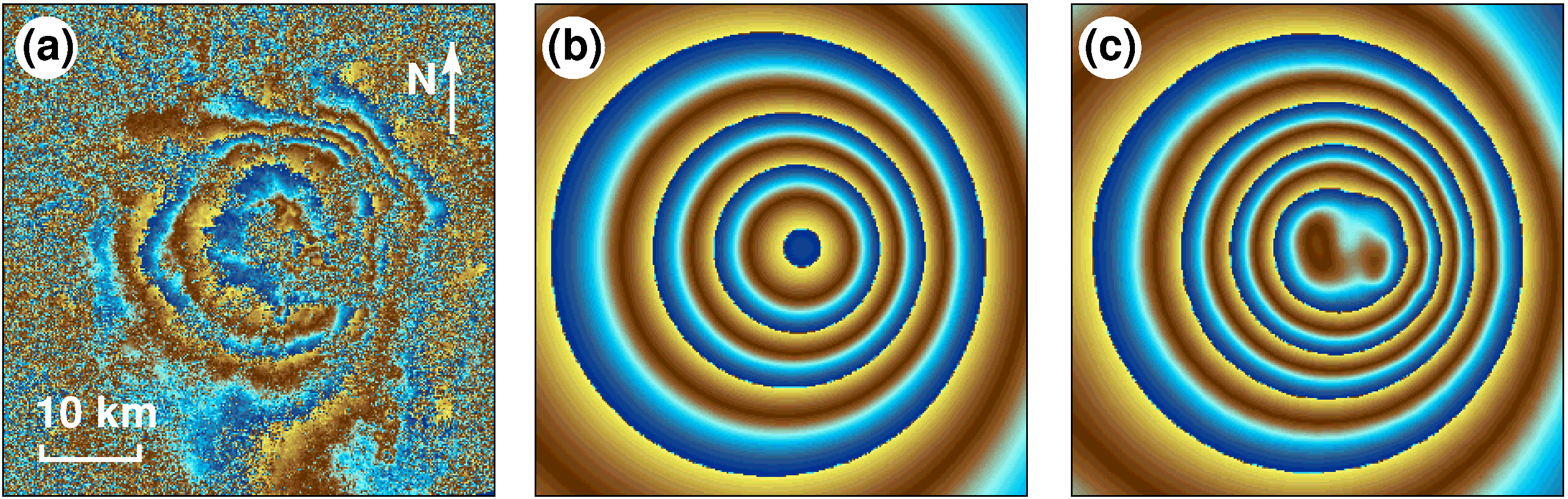
Influence of topography on the deformation signal induced by a spherical source. This interferogram of Etna covering the 1992-1993 period (a) shows a deflation that can be partly modelled by a spherical source located under a prominent volcano (c). When this deformation is modelled by neglecting the topography (b), the deformation signal is less well explained (Cayol et Cornet, GRL, 1998).
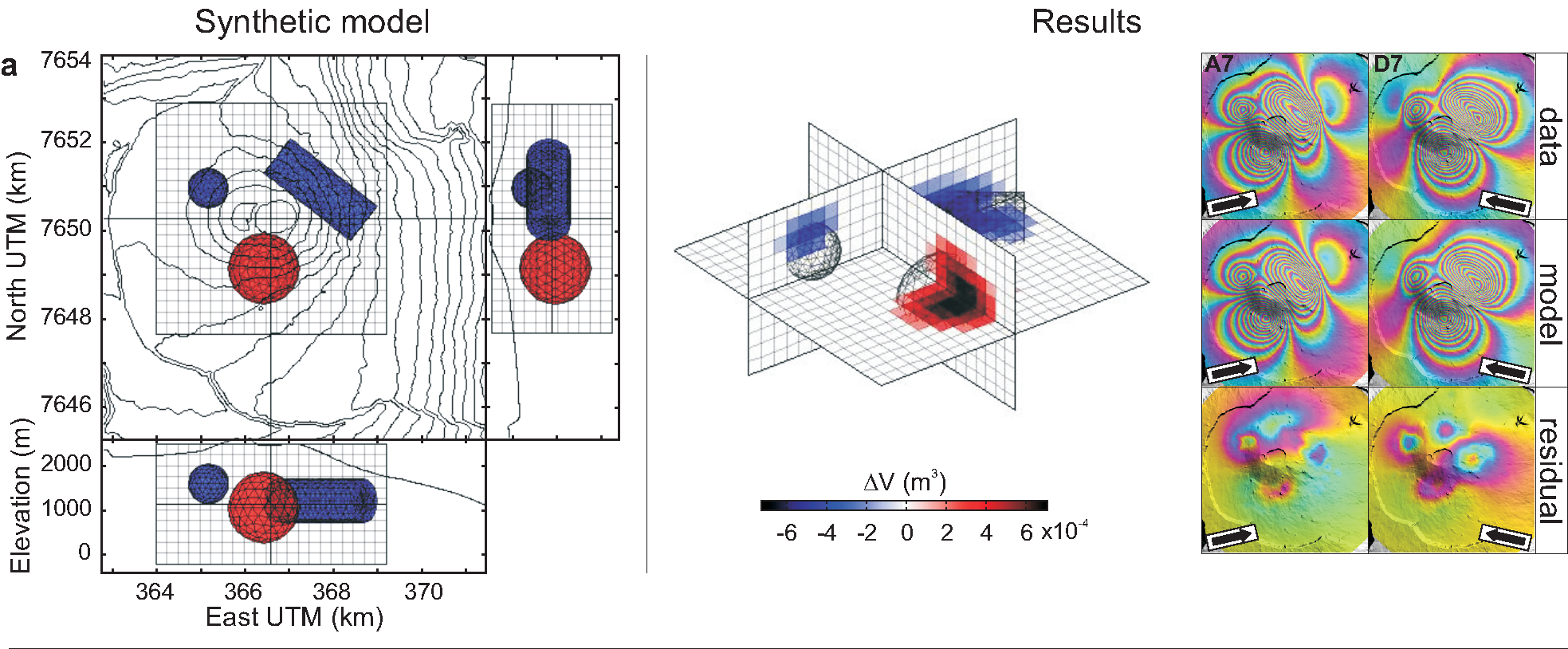
Cluster method for source determination without a-priori on their geometry. Synthetic tests are performed in which a model generated by boundary elements (meshes on the left) is inverted by the cluster method (images in the centre). Different source geometries are superimposed. The method allows to find correctly the geometries of the different sources (Thèse A. Augier).
Study of magma transfer and storage
These methods have been applied to Piton de la Fournaise and the Nyiragongo and Nyamuragira volcanoes in order to study how and where magma is transmitted to the volcanic edifices.
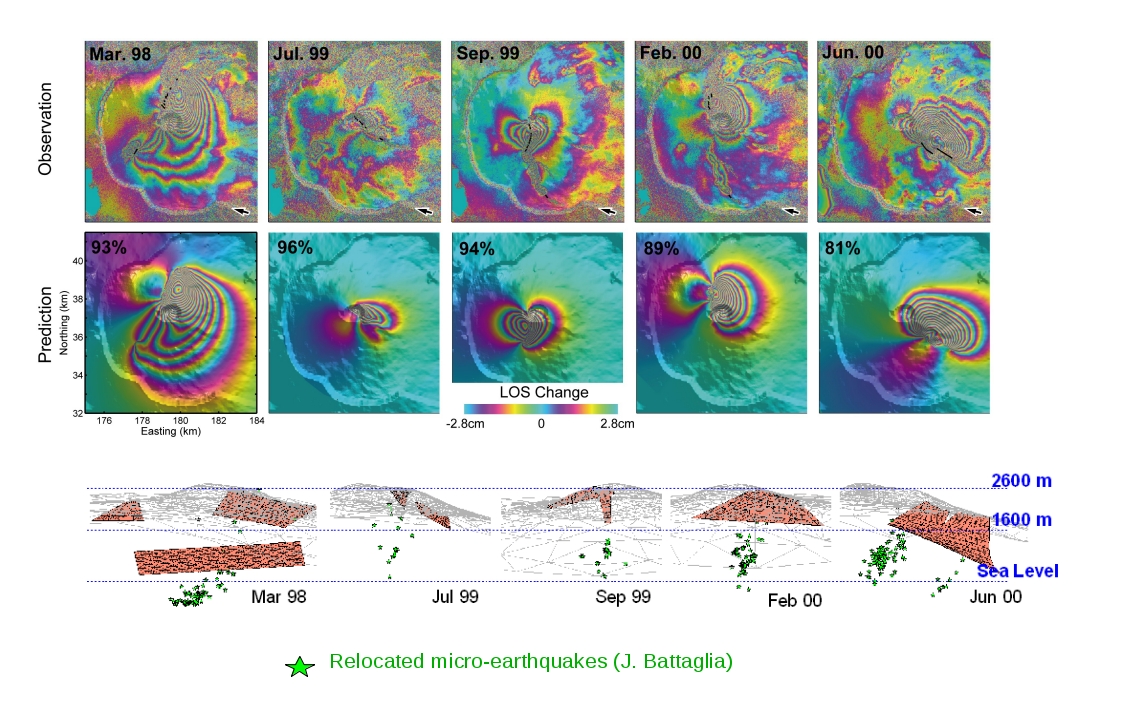
Models for the eruptions of Piton de la Fournaise between March 1998 and June 2000.These models are obtained by analysing RADARSAT-1 data using boundary element modelling combined with near-neighbour inversions (Fukushima et al., JGR, 2005). They show that the eruptions correspond to shallow, horizontally elongated dikes that follow the topography. They dikes are located above the pre-eruptive seismic swarm (Fukushima et al., JGR, 2010).
Models for the January 2002 eruption in Nyiragongo (DRC). Inversions show that the eruption was associated to two dikes: one corresponds to the eruptive fissure and is superficial, the other extends under Lake Kivu for 20 km, and stopped 2 km below the surface (Wauthier et al., JGR, 2012).
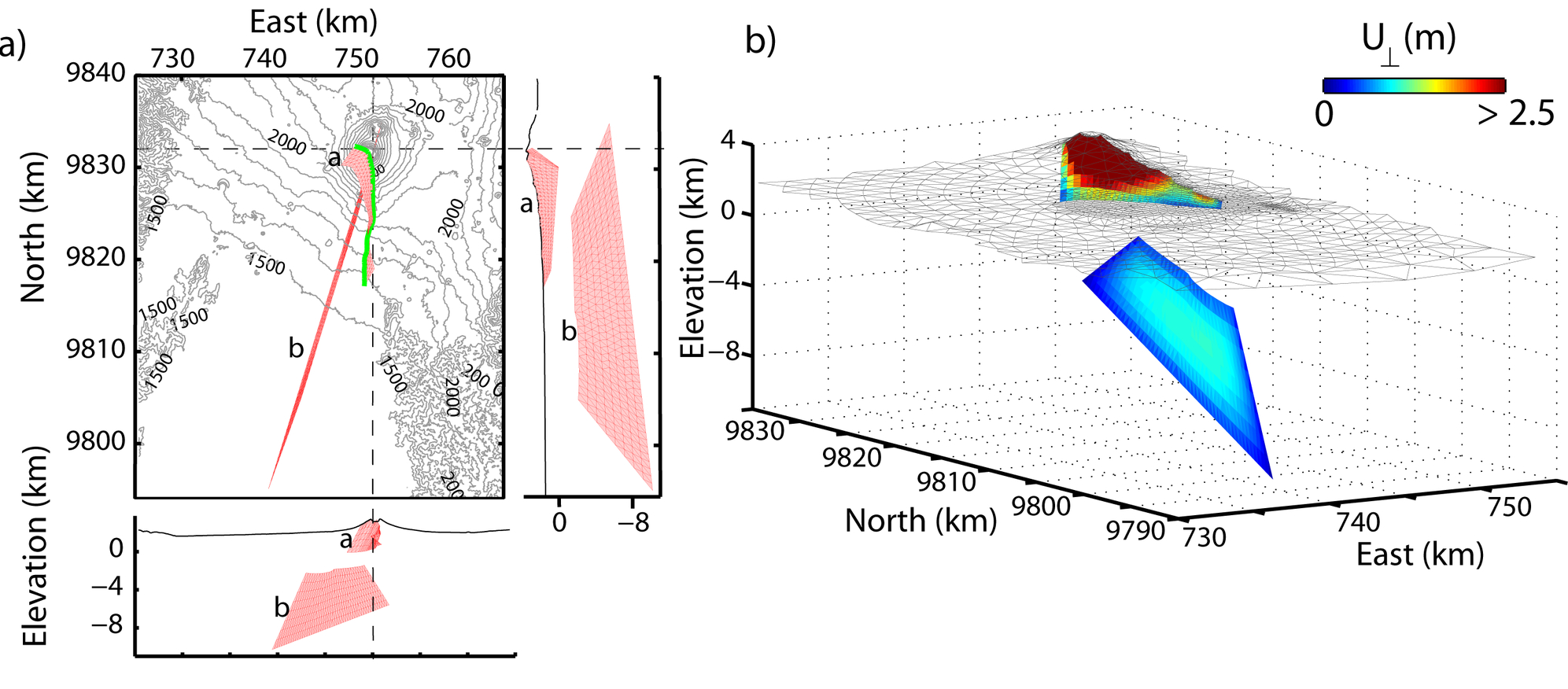
Models for the 2010 Nyamulagira eruption (DRC). For this eruption, the volume emitted is 10 times larger than the reservoir deflation, which can be explained by the compressibility of the magma, containing 0.1wt% CO2 (Wauthier et al., Remote Sensing, 2015).
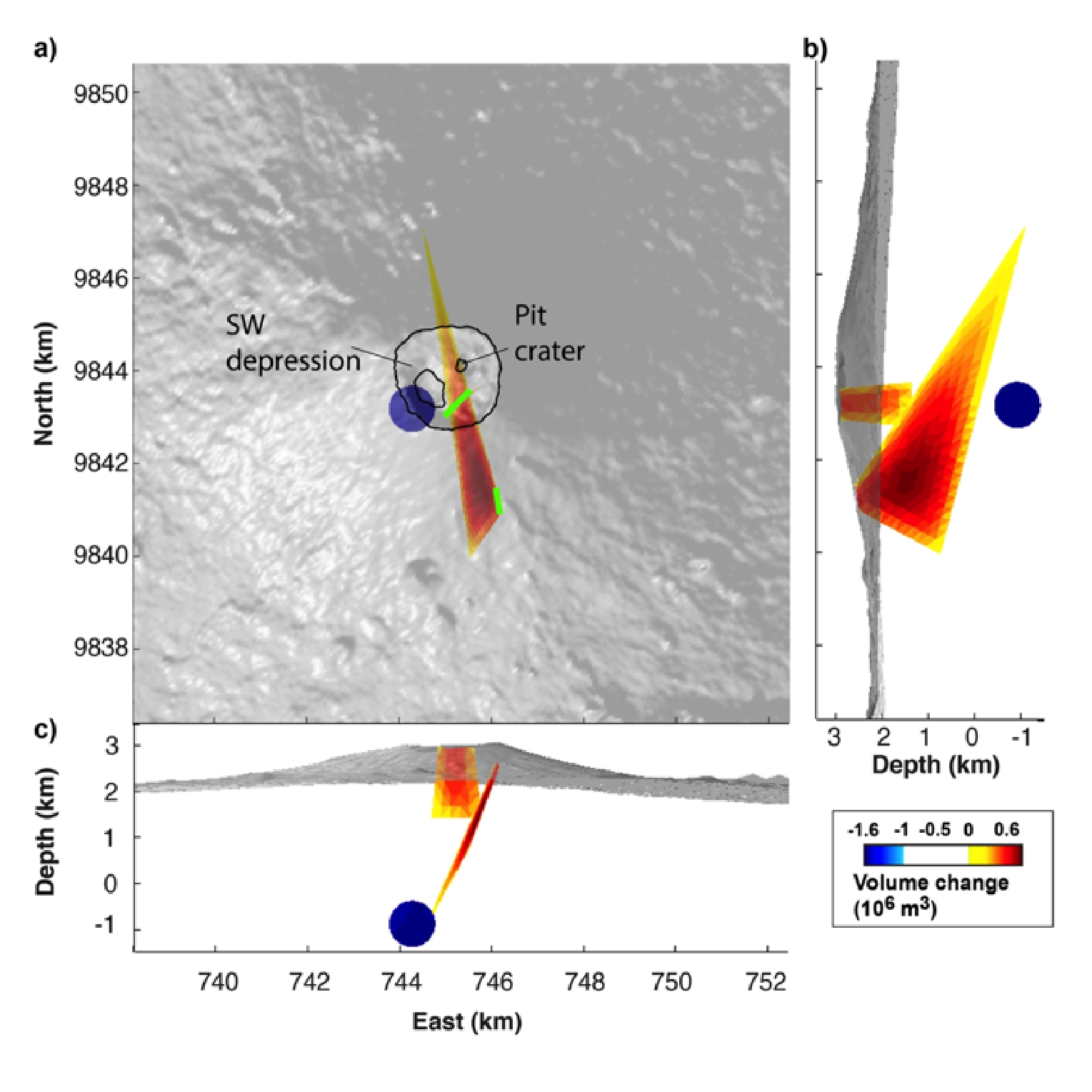
Magma propagation during the May 2016 Piton de la Fournaise eruption. Continuous InSAR and GNSS data were inverted simultaneously to determine how magma propagates from its source to the surface (see Smittarello et al., Remote Sensing, 2019 for the method). We determined that the propagation was jerky with an acceleration phase and a pause before a final dike was established. The volume of magma contained in the intrusion and emitted to the surface is likely to be the result of a single input at the beginning of the eruption. The final phase of propagation could be the result of stress relief from eastern flank slip or pressure from accumulated gas at the upper tip of the sill (Smittarello et al., JGR, 2019).
Study of flank movements of volcanic edifices
Modelling has been carried out at Kilauea, Reunion Island (Piton des Neiges and Piton de la Fournaise) in order to understand the consequences of magma intrusions on the stability of volcanic edifices.
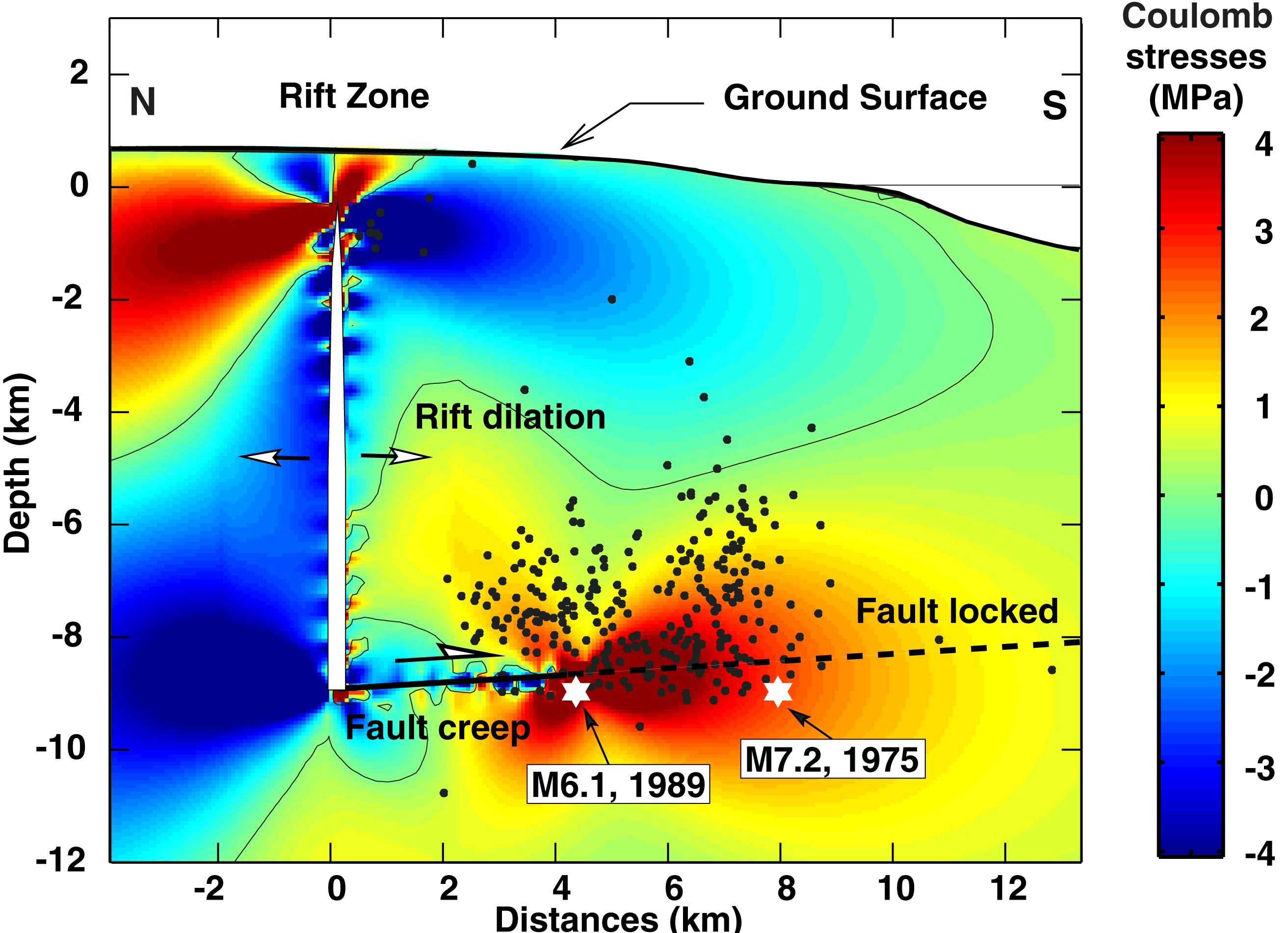
Coulomb stresses induced by the opening of Kilauea’s rift zones, which is coupled with slip on the southern flank of the volcano. This model was established from volcano deformations measured by EDM between 1976 and 1983. It shows that the seismicity is located on the part of the detachment that is blocked (Cayol et al., Science, 2000).
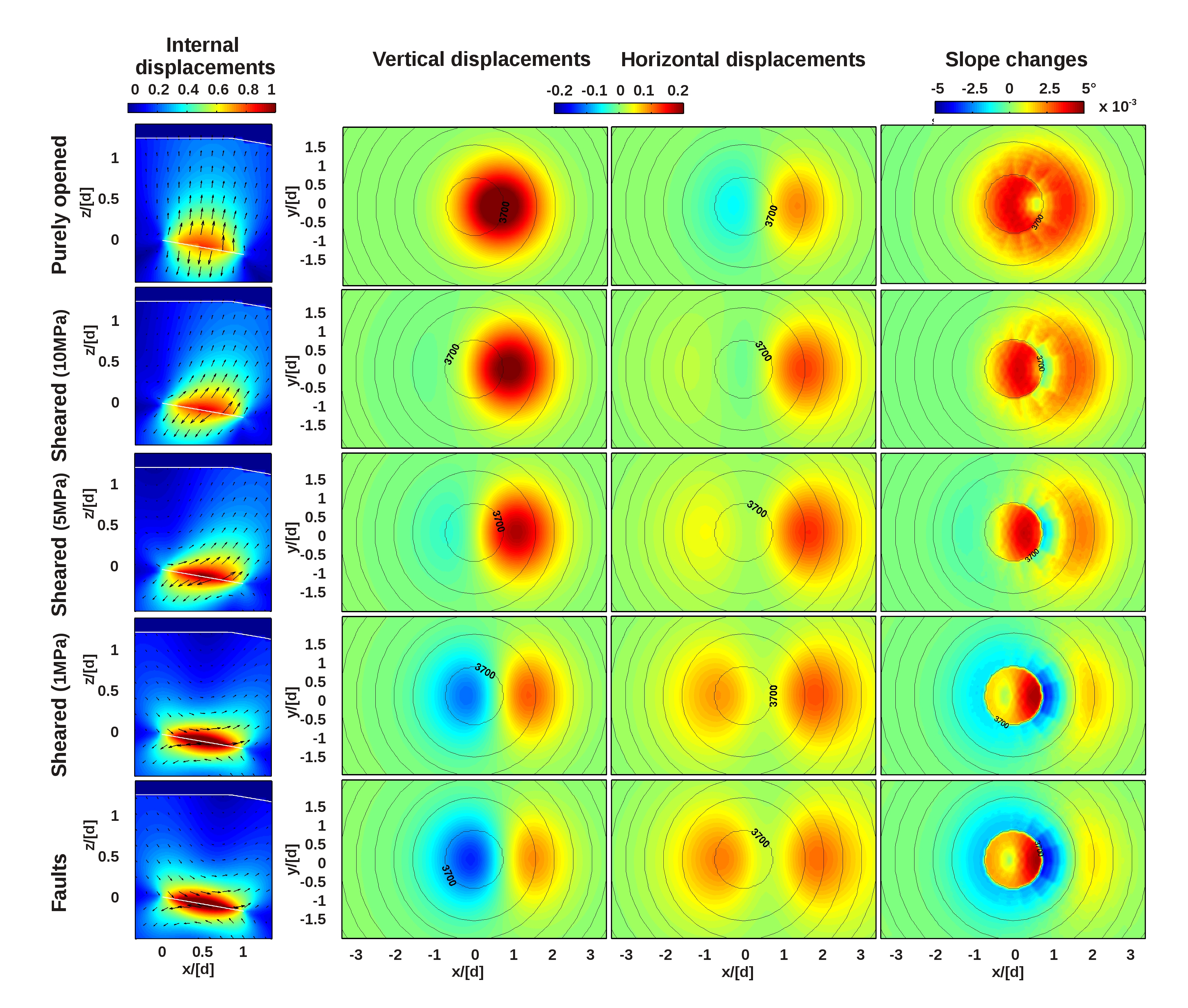
Displacements induced by sill injections, possibly sheared and by faults. This study compares the internal displacement and ground surface displacement induced by a variety of fractures, whether they are intrusions, sheared intrusions or faults. It is assumed that when fractures do not emplace perpendicular to σ3, they shear under gravity (σ1). This case can occur for instance when fractures are guided by pre-existing discontinuities. As magma cancels out friction, the intrusions release shear stresses in the same way as a zero-friction fault. Here k =σ3/σ1 = 0.6 (Cayol et al., JGR, 2014).
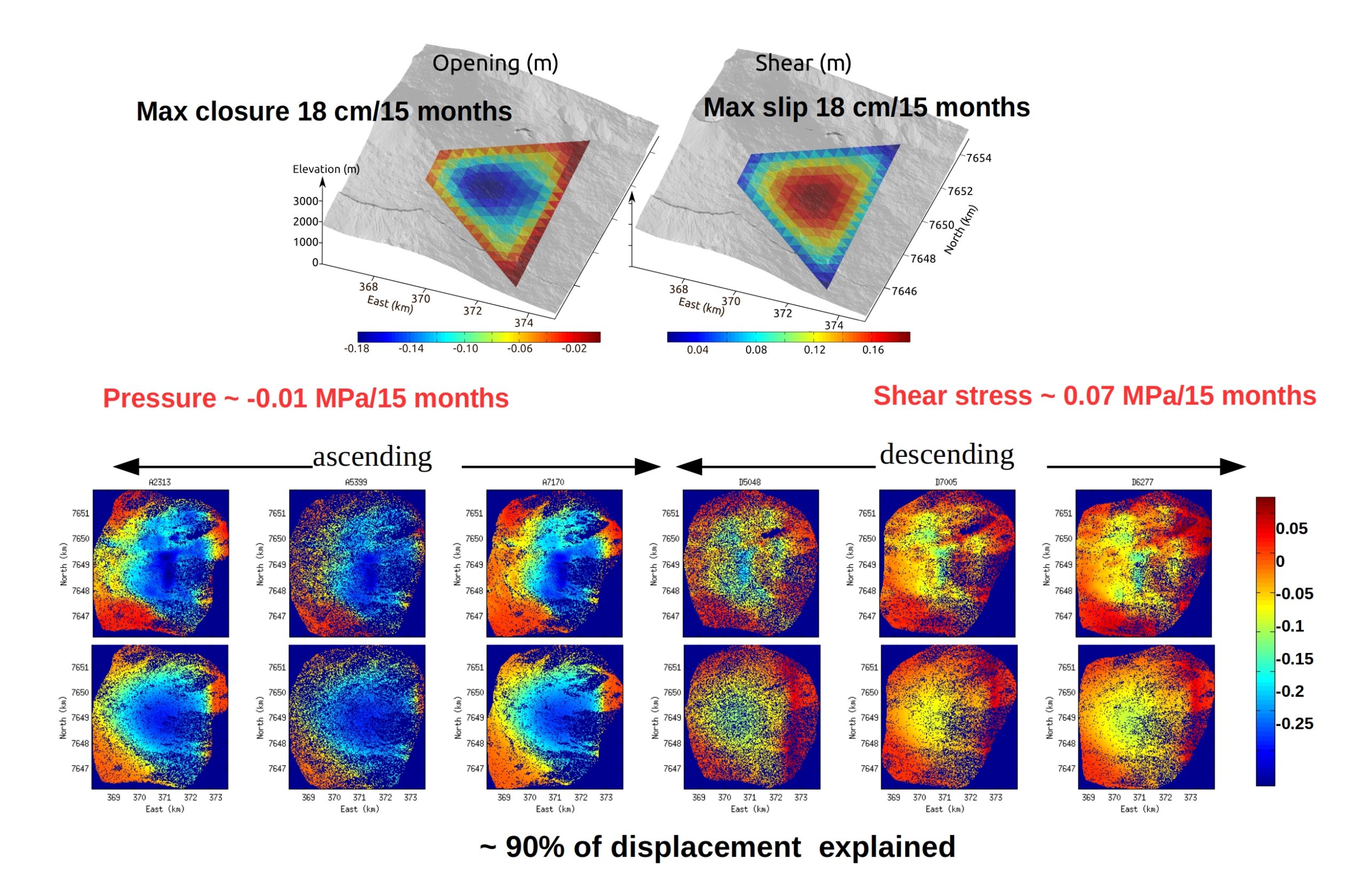
Inversion of the flank displacements that occurred during the April 2007 eruption of Piton de la Fournaise.The April 2007 eruption was exceptional in several respects: the volumes of lava emitted were the largest of the XX and XXI century (240 x 106 m3), a collapse of the summit caldera by 340 m occurred, as well as a flank slip of 1.4 m towards the east. This study aims to understand the origin of the east flank slip. The most commonly accepted model for volcano flank slips is that they result from movement on faults, triggered by repeated magma intrusions. Recently, another flank slip model has been suggested by structural geology studies at Piton des Neiges (Famin et al., 2010; Chaput et al., 2014), the extinct neighbour of Piton de la Fournaise. In this model, flank slip would be induced by the emplacement of intrusions along pre-existing discontinuities, such that the intrusions undergo shearing, similar to that induced on faults. The study of post-2007 flank displacements shows that these are the result of compaction and shearing of a fracture parallel to topography, located 500 m below the ground surface. We find that the compaction is too large to be attributed to a termically contracting sill, and seems rather related to the compaction of a detached fold probably located at the interface between old flows (Tridon et al., JGR, 2016).
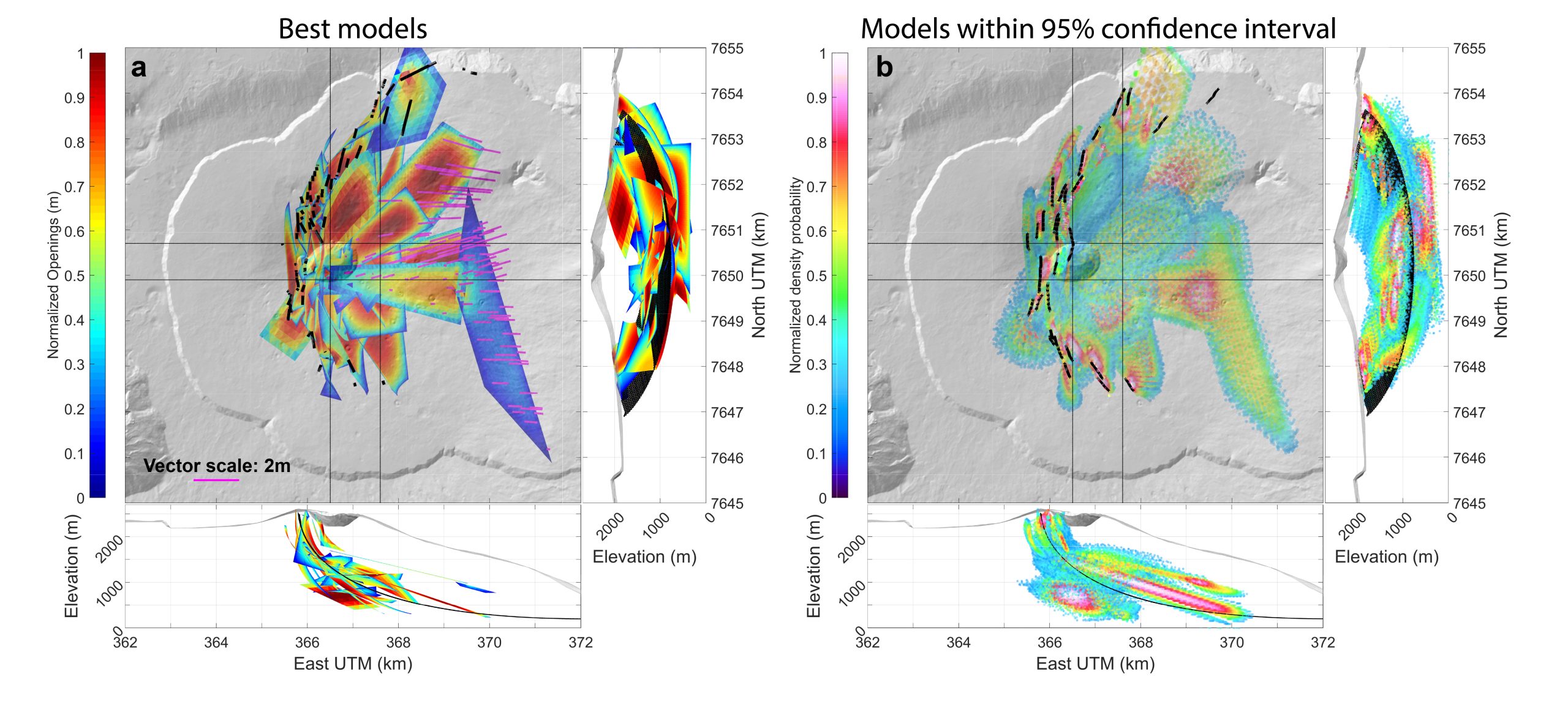
A novel flank-slip mechanism revealed by radar interferometry. By inverting InSAR data covering 57 eruptions that took place between 1998 and 2020, we have shown that most magmatic fractures are guided by a major spoon-shaped structure, open towards the sea. This structure is connected, at the surface, to well-known preferential intrusive zones. The study reveals a novel slip mechanism, characterized by a continuum from opening to pure slip. When the magma is injected into the vertical part of the structure, it opens it in mode I, but when it forces its way into the horizontal part, the latter slips towards the sea; together with the whole flank towards the sea. This structure ends in a seismic fault, which was activated during an eruption in 2007, but which is currently blocked. On the geological time scale, repeated injections of magma into this type of structure could lead to major earthquakes or catastrophic flank collapses (Dumont et al., Nature Communications, 2022). See also the CNRS communication « Un mécanisme de glissement de flanc inédit révélé par interférométrie radar« .
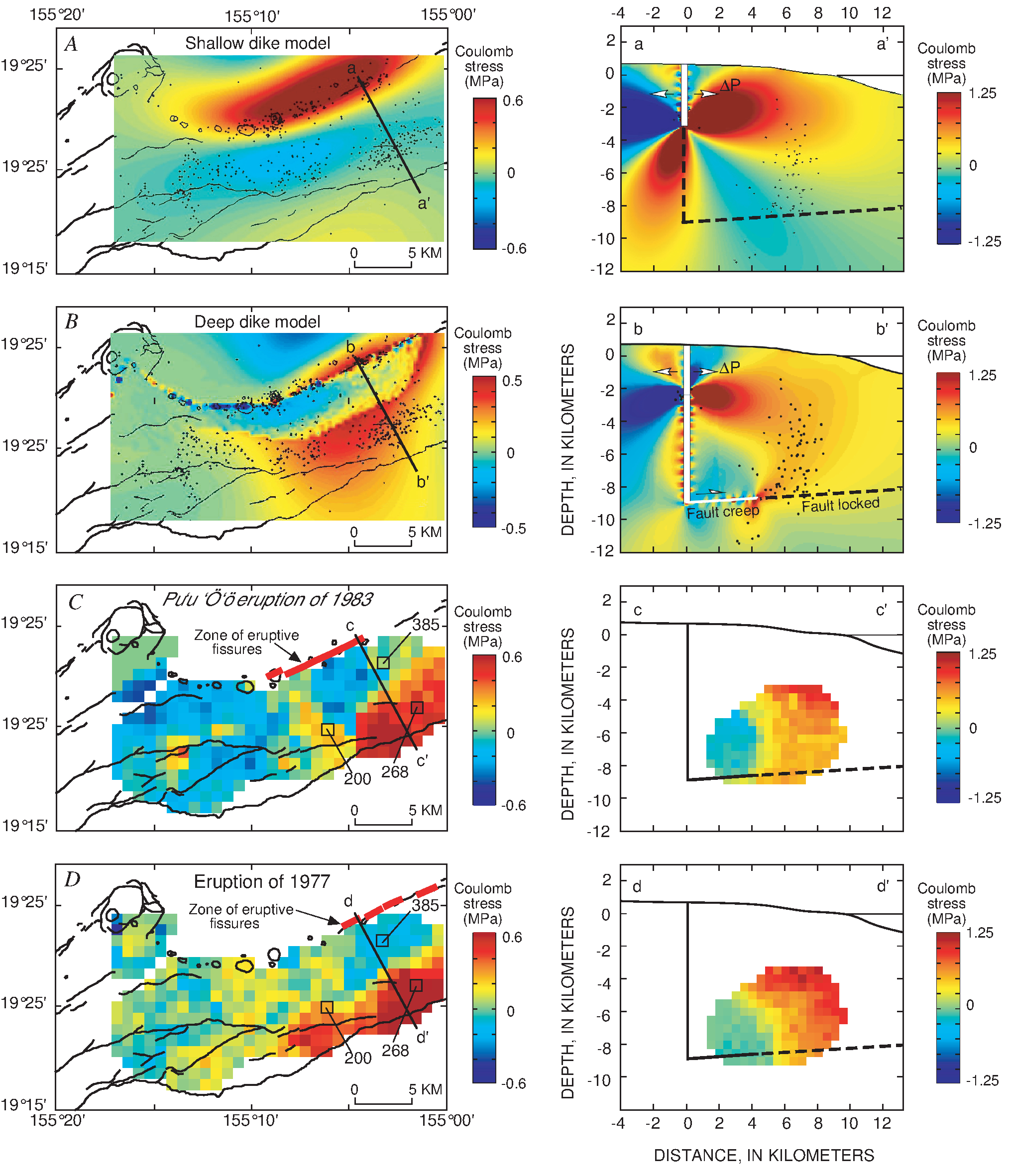
Combining inversions of deformation with inversions of seismic rates for faults whose friction follows rate and state laws
Model for the Kilauea eruptions of 1983 and 1977. By comparing Coulomb stresses from numerical boundary element calculations (A and B) and inversions using seLe décalage déterminé par moindres carrés linéaires donne les modèle inverse très proche du modèle initial. Les discontinuités de densités de ce modèle sont représentées par les lignes blanches (de (Lelièvre et al., GJI, 2019)ismicity rates (C and D), we validated that earthquake rates can be used to infer stress changes and we found that these eruptions corresponded to the vertical propagation of a dike from rift-zones (B), rather than a horizontal propagation from the summit area (A) (Dieterich et al., Nature, 2000; Dieterich et al., USGS Prof. Pap., 2003)
Joint inversion of muography and gravimetry data
Both gravimetric and muographic data are used to determine crustal densities. However, inversions of these data are ill-posed inverse problems. By combining gravity and muography, density determinations are improved. Nevertheless, the inversions depend on hyperparameters (a variance on the a priori density, σρ, and a characteristic smoothing distance, λ), which are most often determined ad-hoc or with reference to a single test case. These hyperparameters have a crucial influence on the recovered densities and their wrong estimation can lead to artefacts. Furthermore, densities imaged by gravimetry and muography often differ by a constant. Our studies, based on a Bayesian formalism, is aimed at developing robust methods for determining the hyperparameters (Barnoud et al., GJI, 2019) and the offset between imaged densities (Lelièvre et al., GJI, 2019). To this end, tests were carried out on a fictitious volcano whose geometry is close to Puy de Dôme. These methods were then applied to Puy de Dôme (Barnoud et al., Frontiers In Earth Sciences, 2021). See the CNRS communication « Voyage au centre du puy de Dôme« .
 The most robust method for determining hyperparameters is the Leave-One-Out method. It consists in determining the parameters that allow the best recovery of measurements at points omitted in the inversion. The minimum of this criterion (white point on the top figure) corresponds well to a model close to the initial model (bottom figures) (adapted from Barnoud et al., GJI, 2019)
 The offset determined by linear least squares gives an inverse model very close to the initial model. The density discontinuities of the initial model are represented by the white lines (de Lelièvre et al., GJI, 2019)
Studied volcanoes:
Piton de la Fournaise (Réunion island, France), Nyiragongo et Nyamulagira (Democratic Republic of the Congo), Kilauea (Hawaii, U.S.A.), La Soufriere (Montserrat, Antilles), Karthala (Grande Comore), Etna (Sicily, Italy).
-
Mentoring:
- Advisor of 7 post-doctorat students: N. Fournier (2004), P. Tinard (2008-2009), S. Court (2013-2015), N. Le Corvec (2016-2018), F. Dabaghi (2016-present), A. Barnoud (2016-2020), S. Lizarazo (2024-actuel, CNES), N. Nasr (2024-2025, ANR DG-Mod).
- Advisor and co-advisor of 11 doctorat research: F. Ranvier (1999-2003), Y. Fukushima (2002-2005), P. Tinard (2004-2007), C. Wauthier, (2007-2011), A. Augier (2008-2011), T. Catry (2009-2011), M. Tridon (2012-), D. Smittarello (2016-2019), , Q. Dumont (2018-2022),M. Colevita (2021-2025), L. Lizé (2025-Actuel).
- Participation in 5 doctorat research: O. Roche (1998-1999), D. Green (2005-2006), A. Hrysiewicz (2016-2019), T. Shreve (2018-2020), A. Iozzia (2022-2024)
- Advisor and co-advisor of 8 master students from LMV (P. Tinard, L. Gailler, C. Wauthier., F. Albino, A. Augier, S. Menassian, Q. Dumont, A. Hautecoeur), 1 from IPGP (Tanguy Roman), 1 from EOST (Ethel Maillard), 1 from LIMOS (A. Kouassi), 1 from U. de Chile (D. Parra), 4 engineer students, 1 computer science undergrad, One geography undergrad.
Scientific and administrative responsibilities:
Present:
- 2026 – present: Member of program committee of the Thematic Resaerch Group dedicated to the use of Numerical methods for solid Earth (NuTS);
- 2023-present: Member of the OPGC Educational Council;
- 2023-present: Member of the Steering Committee of the New Generation Scientific and Technical Intervention and Expertise Unit (CIEST²);
- 2020-present: Member of the scientific committee of the National Observation Service for satellite deformation monitoring ISDeform;
Past:
- 2020-2024: In charge of the Volcanology team;
- 2019-2024 : Member of the Advisory Board of the Center for the Observation and Modelling of Earthquakes, Volcanoes and Tectonics (COMET);
- 2019-2024: member of the organizing committee of the Laboratory of Excellence ClerVolc. In charge of theme 2 dedicated to the structure and the deformation of volcanic edifices.
- 2018-2022: elected member of the scientific committee of Observatoire de Physique du Globe de Clermont.
- 2007-2016: Member of the scientific committee of Vulcania in St Ours.
- 2011-2016: in charge of the computer commission for Laboratoire Magmas et volcans.
- 1999-2003: Member of the laboratory committee for Laboratoire Magmas et Volcans
Research projects:
- 2024-2027 : ANR DGMod (PI, Co-PI O. Bodart and P.-H. Cocquet), »Towards a new generation of joint InSAR – gravity inversions »;
- 2022-2023 : Institut des Mathématiques pour la Planète Terre (IMPT) (Co-PI, PI O. Bodart) « Développement d’une méthode de modélisation conjointe dés déplacements et des variations de gravité »;
- 2021-2022 : ClerVolc LaBeX (PI, Co-PI O. Bodart et J. Koko), « Utilisation de domaines fictifs pour des sources de déformation multiples dans un domaine élastique »;
- 2020 : INSU-ALEAS and ClerVolc LaBeX (PI), “Influence des intrusions sur la stabilité du flanc oriental du Piton de la Fournaise”;
- 2019 : PNTS (Co-PI, PI A. Barnoud) “Inversion et modélisation conjointes des changements de déformation et de gravité associés aux éruptions volcaniques du volcan du Piton de la Fournaise »;
- 2018-2021 : H2020 Integrating and opening infrastructures of European Interest (Participant), « European Network of Observatories and Research Infrastructures for Volcanology »;
- 2017-2018 : Campus France avec le German Center for Geosciences GFZ, Postdam, allemagne (programme Procope), (Co-PI, PIs Virginie Pinel et Eleonora Rivalta) “Modélisation du transport du magma à travers la croûte;
- 2016-2018 : Clervolc (Co-PI, PI C. Carloganu) « Inversion conjointe de données de muographie et gravimétrie;
- 2016-2018 : LaBeX Clervolc (Co-PI, PIs O. Bodart et J. Koko), « Modélisation réaliste et inversion des déformations de fractures en contexte volcanique »;
- 2016 : INSU Aleas (PI), “Suivi de la propagation des intrusions basaltiques par l’inversion des données de déformation au volcan du Piton de la Fournaise”;
- 2013 : INSU Aleas (PI), “Déplacement de flancs associé à l’éruption du Piton de la Founaise en 2007;
- 2013-2015 : LaBeX Clervolc (Co-PI with O. Bodart and J. Koko), « Domaines fictifs pour la modélisation des intrusions de magma »;
- 2007-2009 : ANR Volcarisk (Co-PI, PI O. Merle) “Évaluation de l’aléa sur un volcan de point chaud dans l’océan Indien, l’île de la Réunion”;
- 2005-2007 Programme National deTélédétection Spatiale (PNTS) (Co-PI, PI J.L. Froger), “Vers un suivi opérationnel de l’activité volcanique. Exemple du Piton de la Fournaise;
- 2001-2004 : Projet Européen (Co-PI, PI J. Neuberg), Multi-Disciplinary monitoring, Modelling and Forecasting of Volcanic Hazard;
- 1999-2001 : INSU PNRN (PI) « Risque de déplacement des flancs au Piton de la Fournaise à partir d’une approche structurelle, numérique et analogique ».
Conference organization:
- 2025 : comité d’organisation de la conférence GEOthermals Faults volcanoes and Fluids modeling workshop (GEOFFT), Toulouse.
- 2019 : member of the scientific committee of the MDIS-Form@ter, La Petite Pierre.
- 2017 : Co-organization (with J.L. Froger) of the MDIS-Form@ter, Besse-en-Chandesse.
- 2015 : Member of the organizing committee of the GeoMod, Montpellier.
- 2015 : member of the scientific committee of the MDIS ForM@Ter workshop (Deformation measurement by space imagery), Autrans,.
- 2012: Member of the program committee for the AGU Chapman conference « Hawaiian volcanoes, from source to surface« , Hawaii.
- 2011: Member of the scientific committee for the EFIDIR spring school (fttp://www.efidir.fr) at les Houches,.
- 2001-2004: Seminar organization for the Laboratoire Magmas et Volcans.
- 2012-2014: Steering committee member for Belgium Federal Science Policy Office (Belspo) project on Earth observation VI-X : Study and monitoring of Virunga volcanoes using Tandem-X.
Evaluation activities:
- 2024: president of a recruting committee for a professor position at LMV, UCA.
- 2023: Evaluation committee for five “Fire of Love” research grants awarded in memory of Maurice and Katia Kraft to researchers in developing countries.
- 2017 – 2023: Member of the evaluation committee of the CNRS-INSU TelluS-ALEA projects.
- 2018-2019 : Participation to the selection committee for the Fulbright fundation au comité de selection de la fondation Fulbright for exact and applied sciences, and for earth and life sciences. Evaluation of researchers and PhD student projects.
- Member of recruiting committees at ISTerre at Université de Savoie (2010), Institut de physique du Globe de Paris (2019), Université de Loraine, CRPG, Nancy (2021), Université de la Réunion, St Denis, La réunion (2022), Ecole Normale Supérieure in Paris (2024).
- 2012 and 2001: Member of the permanent Jury for Master2 at LMV.
- Reviews for Nature Geoscience, Tectonophysics, Journal of Geophysical Research, Geophysical research Letter, Journal of Volcanology and Geothermal Research, Physics of the Earth and Planetary Interior, Bulletin of Volcanology.
- Reviews of projects for the U.S. National Science Fundation, Icelandic Research Fund, Observatoire des Sciences de l’Univers de Grenoble (OSUG), for the Italian Instituto Nazionale di Geofisica E Vulcanologica (INGV).
PhD Examinations:
- 9 as examiner: Aline Peltier at the University of Réunion (July 2008); Paola Traversa at IsTerre, Joseph Fourier University in Grenoble (October 2009); Fabien Albino at IsTerre, University of Savoie, Chambery (January 2011); Andrew Toombs at the University of Reading (June 2011); Aline Schmid at IsTerre, Joseph Fourier University in Grenoble (Oct. 2011); Anne Obermann at Isterre, Joseph Fourier University in Grenoble, (Nov. 2013); Cyril Journeau, IsTerre, University of Grenoble Alpes (Sept. 2022); Angèle Laurent, Institut de Physique du Globe de Paris (April 2023); Francesco Bagnioli, Institut de Physique du Globe de Paris (December 2024); Yagizalp Okur, Tohoku University (July 2025);
- 10 as referee: Timothy Davis, Institute of Earth and Environmental Science, GFZ, Potsdam, Germany (May 2021); Camilla Novoa, Laboratoire Geosciences Environnement Toulouse, Toulouse (June 2021); Raphael Bajou, Institut de Physique du Globe de Paris (June 2023); Nicolas Mercury, Institut Terre et Environnement, University of Strasbourg (December 2023); Pierre Boymond, Institut de Physique du Globe de Paris (April 2024); Shan Grémion, University of Savoie Mont-Blanc (November 2024); Alexandra Le Contellec, Ecole Normale Supérieure de Lyon (December 2024); Lise Firode, Institut de Physique du Globe de Paris (April 2025); Martin Foin, University of Montpellier (November 2025); Clément de Sagazan, Institut de Physique du Globe de Paris (December 2025);
Habilitation to conduct research jury:
- Béatrice Puysségur, Ecole Normale Supérieure de Paris Saclay (Décembre 2024).
Distinctions:
- 2016-2017 : Fulbright researcher grant of 6 mois for the Cascade Volcano Observatory;
- Citation for Excellence of a Review at Geophysical Research Letter (2019);
-
- Subjects : Numerical modelling, rock mechanics, geophysics.
- Niveau : Master 1, Master 2.
-
Collaborations:
- Laboratoire SIAME, Université de Pau.
- Laboratoire de Mathématiques de l’Institut Camille Jourdan in St Etienne.
- laboratoire de Mathématiques (LM) et Laboratoire d’Informatique, Modélisation et Optimisation des Systèmes (LIMOS), Laboratoire de Physique Corpusculaire (LPC) de l’Université B. Pascal.
- IsTerre, Université de Savoie, Le-Bourget-du-Lac
- Université de la Réunion, IPGP.
- Royal Museum for central Africa, Tervuren, Belgium.
- National Museum of Natural History, Walferdange, Luxembourg
- Research Center for Earthquake Prediction, Disaster Prevention Research Institute, Kyoto University, Japan.
- The Pennsylvania State University, Etats-Unis
- UC Riverside, Etats-Unis.
- Cascade Volcano Observatory, U.S.G.S.
- Instituto Nazionale di Geofisica e Vulcanologia, Catania, Italy.
Journeys in foreign laboratories:
- 2016-2017: Journey at the Cascade Volcano Observatory of l’U.S. Geological Survey, Fulbright Research Grantee.
- 1996-1997: Post-Doctorat at the U.S. Geological Survey in Menlo Park, Californie, U.S.A. Research subject : joint inverions of micro-earthquakes and deformations to determine stress changes associated to Kilauea (Hawaii).
-
Publications since 2010:
Previous publications:
- Battaglia J. and V. Cayol, A comment on « Hidden dykes detected on Ultra Long Period seismic signals at Piton de la Fournaise volcano ? » by Houlié N. and Montagner J.-P., Earth Planet. Sc. Let., 287, 1-2, 284-287, doi:10.1016/j.epsl.2009.06.023, 2009. Download from HAL
- Peltier A., Hurst T, Scott B., Cayol V., Structures involved in the vertical deformation at Lake Taupo (New Zealand) between 1979 and 2007: New insights from numerical modelling, Volcano. Geotherm. Res., 181, 173–184, doi:10.1016/j.jvolgeores.2009.01.017, 2009. Download from HAL
- Peltier, A., T. Staudacher, P. Bachèlery, V. Cayol, Formation of the April 2007 caldera collapse at Piton de La Fournaise volcano: insights from GPS data, J. Volcano. Geotherm. Res., 184, 152-163, doi:10.1016/j.jvolgeores.2008.09.009, 2009. Download with HAL
- Michon L., V. Cayol, L. Letourneur, A. Peltier, N. Villeneuve, T. Staudacher, Edifice growth, deformation and rift zone development in basaltic setting: insights from Piton de la Fournaise shield volcano (Réunion Island, Indian Ocean). J. Volcanol. Geotherm. Res., 184, 14–30, doi:10.1016/j.jvolgeores.2008.11.002, 2009. Download with HAL
- Peltier A., V. Famin, P. Bachèlery, V. Cayol, Y. Fukushima, T. Staudacher, Cyclic magma storages and transfers at Piton de La Fournaise volcano (La Reunion hotspot) inferred from deformation and geochemical data, Earth. Planet. Sci. Lett., 270, 2-4, 180-188, doi:10.1016/j.epsl.2008.02.042, 2008. Download with HAL
- Green, D. N.*, J. Neuberg, and V. Cayol, Shear stress along the conduit wall as a plausible source of tilt at Soufrière Hills volcano, Montserrat, Geophys. Res. Lett., 33, L10306, doi:10.1029/2006GL025890, 2006. Download
- Fukushima Y.*, V. Cayol and P. Durand, Finding realistic dike models from interferometric synthetic aperture radar data: The February 2000 eruption at Piton de la Fournaise, J. Geophys. Res., 110, B03206, doi: 10.1029/2004JB003268, 2005. Download
- Dieterich J., V. Cayol, and P. Okubo, Stress Changes Prior to and During the Pu’u O’o Eruption of Kilauea Volcano, U.S. Geological Survey Prof. Paper, 1676, 187-201, 2003. Download
- Dieterich, J., V. Cayol et P. Okubo, The Use of Earthquake rates as a stress-meter at Kilauea Volcano, Nature, 408 : 457-460, 2000. Download with HAL
- Cayol, V., J. Dieterich., A. Okamura et A. Miklius, High Magma Storage Rates Before the 1983 Eruption of Kilauea, Hawaii, Science, 288, 2343-2346, 2000. Download with HAL
- Briole, P., A. Avallone, F. Beauducel, A. Bonforte, V. Cayol, C. Deplus, C. Delacourt, J.-L. Froger,] B. Malengreau, G. Puglisi, Interférométrie radar appliquée aux volcans : cas de l’Etna et des champs Phlégréens (Italie), Comité National Français de Géodésie et Géophysique, Rapport quadrienal 1995-1998, 121-128, 1999.
- Cayol, V., et F. H. Cornet (1998), 3D Modeling of the 1983-1984 Eruption at Piton de la Fournaise Volcano, Réunion Island, Indian Ocean, J. Geophys. Res., 103,18,025-18,037, 1998. Download
- Cayol, V., and F.H. Cornet, Effect of Topography on the interpretation of the deformation field of prominent volcanoes – Application to Etna, Geophys. Res. Let., 25, 1979-1982, 1998. Download with HAL
- Cayol, V., et F. H. Cornet, 3D Mixed Boundary Elements for Elastic Deformation Field Analysis, Int. J. Rock Mech. Min. Sci.& Geomech. Abstr., 34, 275-287, 199.
*Ph. D. study under my supervision
Conferences and invited seminars :
- Cayol, V., C. Wauthier, N. D’Oreye, F. Kervyn, M. Tridon, J.L. Froger, Assets of determining stress changes from InSAR displacement with examples from the Kivu Volcanic Region and Piton de la Fournaise volcano, COMET annual meeting, York, U.K., Juin 2019.
- Cayol, V., Smittarello D., V. Pinel, A. Peltier, J.-L. Froger, magma associated to Piton de la Fournaise eruptions from joint inversion of InSAR and GNSS data, 26ème Réunion des Sciences de la Terre, Lille, France. Nov., 2018.
- Cayol, V., A. Augier, S. Court, J.−L. Froger, S. Menassian, Improved Cluster of Volume Strain Method Applied to Volcano Deformation, IAVCEI 2017 Scientific Assembly, Portland, USA, aout 2017.
- V. Cayol, Detecting intrusions from deformations with applications to Piton de la Fournaise and Nyiragongo, Earth Flow seminar, Oslo, June 2016.
- V. Cayol, Methods for tracking magma movements from deformation with applications to Piton de la Fournaise and RDC volcanoes, MEMOVOLC workshop, Feb. 2015.
- V. Cayol, Wauthier, C., F. Kervyn and N. d’Oreye, Magma driven extension in an immature continental rift based on InSAR observations of Nyiragongo Volcano in 2002, 96th Journées Luxembourgeoises de Géophysique, 24-25 novembre 2011.
- Wauthier*V.Cayol, et al., Nyiragongo Volcano 2002 Eruption Constrained by Multibeam InSAR Data, European Geophysical Union, Avril 2011.
- Cayol V., Augier A., et J.L. Froger, Apports de l’interférométrie radar à l’étude de l’éruption de mars-avril 2007 au Piton de la Fournaise, Colloque autour de l’ANR EFIDIR, Aussois, 1-3 avril 2010.
- Cayol V., J.-L. Froger,Y. Fukushima, A. Augier, Ph. Durand et D. Massonnet, Apports de l’interférométrie radar à la connaissance du Piton de la Fournaise, Ecole thématique du CNRS « Identification à partir des mesures de Champs – Application à la mécanique des matériaux et des structures », Clermont-Ferrand, Juin 2009.
- Cayol V.,, C. Wauthier, N. D’Oreye, F. Kervyn, Deformation modelling from multiswath InSAR data at Nyiragongo and Nyamulagira volcano, Workshop, Evaluating, Monitoring and Communicating Volcanic and Seismic Hazards in East Africa, Trieste, Italie, 17-28 August 2009.
- Cayol V., Tinard P., Froger J.-L., Fukushima Y. : New Insights on Piton de la Fournaise Volcanic Activity Inferred from a Multiple Swath InSAR Monitoring (La Réunion Island), Assemblée Générale de l’IAVCEI, Reykjavik, Islande, août 2008.
- Cayol, V., Y. Fukushima, P. Tinard, J.-L. Froger, Ph. Durand, T. Souriot et D. Massonnet : Apports de la télédétection spatiale à la connaissance du Piton de la Fournaise, La Réunion face aux risques naturels : gouvernance locale et coopération régionale , St Denis de la Réunion, septembre 2006.
- FukushimaV. Cayol, P. Durand, and D. Massonnet, Complex dike emplacements at Piton de la Fournaise revealed by InSAR and their implications on the magma transfer mechanism, Western Pacific Geophysics Meeting, Beijing, China, Juillet 2006.
- V. Cayol, Fukushima, Y., Geometry of magmatic conduits at Piton de la Fournaise, European Geophysical Union, Vienne, Autrice, Avril 2006.
- V. Cayol, Fukushima, Y., P. Durand: Finding realistic dike models from Insar Data: Applications to 1998-2000 eruptions at Piton de la Fournaise, RSPSoc Annual Meeting, Portsmouth, G.B., Septembre 2005.
- Dieterich J. H., Cayol, V., Okubo, P.: Stresses Associated to the Onset of the Pu’u ‘O’o-Kupaianaha Eruption, American Geophysical Union, San Francisco, U.S.A., Décembre 2003.
- Invited seminars at department of seismology IPGP; laboratoire de Géophysique Interne et Tectonophysique (LGIT) of University J. Fourier, Grenoble (1998); laboratoire de Dynamique Terreste et Planétaire, Observatoire Midi Pyrénée, University of Toulouse; laboratoire de Mécanique des Roches, IPGP; department of Geophysics of the University of Leeds (2003); University J. Fourier, Grenoble (2009); Univ. de la Réunion, Penn State University, Cornell University, University of Oregon, Eugene, OR, USA (May 2017); USGS Cascade Volcano Observatory, Vancouver, WA, USA (May 2017); University of California Riverside, Riverside, CA, USA (May 2017); Ecole normale Supérieur de Paris (2018); Laboratoire de Géologie, Université Lyon 1 (2019).
185 conference communications
-
Outreach :
- 2025 : Participation to a round table after the projection of the film « Goma: Living with the risk of Nyiragongo’s eruptions », Africa Museum, Tervuren, Belgium
- 2025: Conference on “Volcanic Curiosities and Anomalies” at the Université pour tous in Saint Laurent du Var
- 2024: EPOS podcast on “Modeling Volcanic Deformation”
- 2022: Conference on “Deformation as Seen by Space Imagery” for the Université Ouverte, Université Clermont Auvergne
- 2022: Participation in the Nuées Ardentes festival
- 2018: Presentation on volcanoes at the Rive de Giers primary school
- 2013: Guest at the Oullins film festival for the film “Memoire de Volcans” by F. de Riberolles, Oullins, France.
- 2006: Invited seminar : « Apports de la télédétection spatiale à la connaissance du Piton de la Fournaise » to the conference « La Réunion face aux risques naturels : gouvernance locale et coopération régionale », St Denis, La Réunion.
Medias :
- 2025 : Interview to the journal le Parision on the 2 juin 2025, Etna’s eruption.
- 2023 : Commmunication to the Epsiloon journal on eruption prevision.
- 2022 : Communication to the CNRS journal « Un mecanisme de glissement de flanc de volcan inedit revele par imagerie satellitaire« .
- 2022 : communication to the CNRS journal « Une éruption volcanique sans précurseur clair, ça peut se produire« .
- 2021 : interview to the Sud Ouest journal on the Nyiragongo 2021 eruption.
- 2021 : Interview to the journal La Croix on the Nyiragongo 2021 eruption.
- 2021 : communication to the CNRS Journal « Voyage au centre du puy de Dôme«

